18 Common Things That Are Exactly 3 Inches Long
You’re looking at a product listing, a recipe, or a weather report, and it just says 3 inches. Without a ruler nearby, that number doesn’t really mean much. Is it tiny? Noticeable? Would it fit in your pocket, or take up most of a shelf?
Most people know that 3 inches equals 7.62 centimeters. But knowing a conversion and actually picturing a size are two different things. Your brain understands length much better through objects you’ve held than through decimal points on a screen.
This guide gives you both. Below you’ll find every conversion you’re likely to need, plus 18 real, everyday objects that measure exactly 3 inches, grouped by category so you can skip to whatever’s relevant to you. There are also a couple of things almost no other guide on this topic bothers to explain: what 3 inches actually means in a weather forecast, and what it means when you’re cutting wood or checking a legal blade-length limit.
- Quick Answer: How Long Is 3 Inches?
- 3 Inches on a Ruler: What It Actually Looks Like
- 3 Inches in Every Unit (Full Conversion Table)
- What Does 3 Inches Look Like? (Body Comparisons)
- 18 Everyday Things That Are Exactly 3 Inches
- Office & Stationery
- Sports
- Home & DIY
- Kitchen
- Everyday & Health
- Money & Small Objects
- 3 Inches vs. Other Common Measurements
- How to Measure 3 Inches Without a Ruler
- 3 Inches of Rain or Snow: What It Actually Means
- 3 Inches in DIY, Woodworking & Legal Contexts
- Where 3 Inches Shows Up in Real Life
- People Also Ask
- Quick FAQs
- Conclusion
Quick Answer: How Long Is 3 Inches?
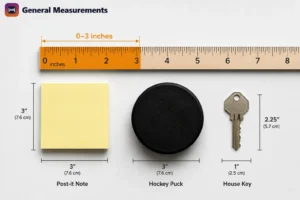
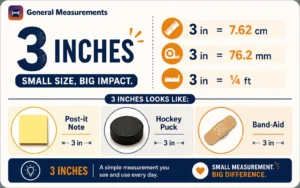
3 inches equals 7.62 centimeters, 76.2 millimeters, 0.25 feet (¼ foot), and 0.0833 yards. Think of it as roughly the width of a sticky note, the diameter of a hockey puck, or about three adult fingers held side by side.
| Unit | 3 Inches Equals |
|---|---|
| Centimeters | 7.62 cm |
| Millimeters | 76.2 mm |
| Feet | 0.25 ft (¼ ft) |
| Yards | 0.0833 yd |
| Meters | 0.0762 m |
| Feet + Inches | 0 ft 3 in |
| Fraction (of a foot) | 1/4 ft |
3 Inches on a Ruler: What It Actually Looks Like
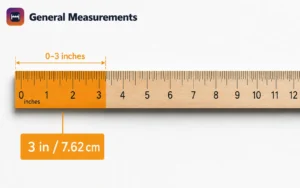
Pull out a standard 12-inch ruler and 3 inches lands right at the first quarter mark, between the “2” and the “4.” It’s shorter than a dollar bill laid flat. Shorter than most smartphones. Shorter, even, than the average adult palm.
Most people expect it to look smaller than it does, though. Once you actually see 3 inches marked out instead of just hearing the number, it reads as a length you’d notice sitting on a table, not some tiny sliver you’d miss.
3 Inches in Every Unit (Full Conversion Table)
If you need 3 inches converted for design work, printing, or international use, here’s the full breakdown:
| Unit | Value |
|---|---|
| Nanometers | 76,200,000 nm |
| Micrometers | 76,200 µm |
| Millimeters | 76.2 mm |
| Centimeters | 7.62 cm |
| Meters | 0.0762 m |
| Kilometers | 0.0000762 km |
| Feet | 0.25 ft |
| Yards | 0.0833 yd |
| Miles | 0.0000473 mi |
| Pixels (72 DPI, web) | 216 px |
| Pixels (96 DPI, standard screen) | 288 px |
| Pixels (300 DPI, print) | 900 px |
The formula is simple: multiply inches by 2.54 to get centimeters. 3 × 2.54 = 7.62 cm. That’s it, no matter how many times you need to recheck it.
If you’re working from a tape measure with fraction markings, 3 inches falls exactly on the whole-inch line, so there’s no fraction to fuss with. It’s worth knowing, though, that 3 inches equals 24/8″, 48/16″, or 96/32″ of an inch, in case you’re measuring from a starting point that isn’t a clean number.
What Does 3 Inches Look Like? (Body Comparisons)
No ruler around? Your hands are a decent backup.
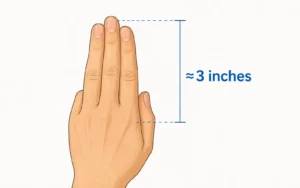
Press your index, middle, and ring finger together, and for most adults that combined width lands close to 3 inches. Or measure from the tip of your middle finger down to the second knuckle. That’s usually about 3 inches too. As for palm width, 3 inches covers a bit more than half the width of an open adult palm.
None of these are precise, but they’re accurate enough to trust when you’re shopping, cooking, or sizing up a small DIY task and don’t want to dig out a tape measure.
18 Everyday Things That Are Exactly 3 Inches
These are real, checkable objects, sorted by where you’d actually run into them.
Office & Stationery
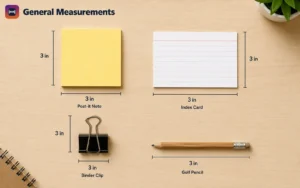
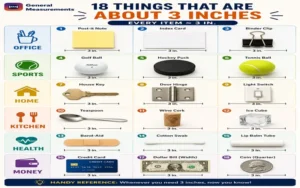
1. Standard 3×3 Post-it Note 3M’s original Post-it Note measures exactly 3 inches on every side, and has since it launched nationally back in 1980. Every brand that makes sticky notes has stuck with that size since. If there’s one object on this list sitting within arm’s reach right now, it’s probably this.
2. Short Side of a 3×5 Index Card The most common index card in the U.S. measures 3 by 5 inches, and the short edge is exactly 3 inches. That size dates back to the late 1800s, chosen because it gave enough writing space while still fitting in a pocket. It hasn’t changed since.
3. Extra-Large Binder Clip The heavy-duty binder clips used for thick stacks of paper have a jaw opening of exactly 3 inches. That width lets them clamp down on roughly 250 sheets while still being easy to squeeze open with one hand.
4. Golf Pencil (Library Pencil) Those short, pre-sharpened pencils you find at golf courses, bowling alleys, and libraries run between 3 and 3.5 inches, with most sitting right around 3. The stubby length isn’t an accident. It’s built that way so the pencil fits in a scorecard holder without slipping out.
Sports
5. NHL Hockey Puck (Diameter) An official NHL puck measures exactly 3 inches across, 1 inch thick, and weighs 5.5 to 6 ounces. All three numbers are written directly into the league rulebook. That diameter isn’t random either. It’s tuned to keep the puck controllable on a stick while still traveling fast and staying visible on broadcast.
6. Baseball (Diameter) A regulation MLB baseball runs between 2.86 and 2.94 inches across, just a touch under 3 inches. Close enough that holding one gives you a genuinely accurate feel for the size.
7. Tennis Ball (Diameter) A regulation tennis ball measures 2.7 inches in diameter. Set it next to something that’s actually 3 inches and the gap is easy to see, which makes it a handy “a little smaller than” reference.
Home & DIY
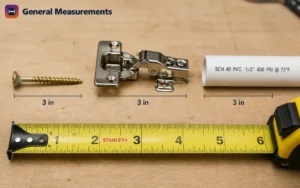
8. Standard 3-Inch Wood Screw The 3-inch wood screw is one of the most common fastener lengths in home construction, measured from the tip to just under the head. It’s long enough to pass through a standard 2×4 stud and dig solidly into the framing behind it.
9. Cabinet Hinge (Fully Open) Small residential cabinet hinges, the kind on your kitchen and bathroom doors, measure 3 by 3 inches when opened flat, with each leaf coming in at 3 inches. So the next time you open a kitchen cabinet, you’re looking at a built-in size reference you never noticed before.
10. 3-Inch PVC Pipe (Nominal Diameter) When a plumber says “3-inch pipe,” they mean the nominal diameter, which is the number printed on the pipe itself and used across the whole industry, even though the actual outer diameter runs a bit larger, closer to 3.5 inches.
11. Standard Door Knob (Diameter) Most residential door knobs measure between 2.75 and 3 inches across. That range wasn’t picked at random. It’s roughly what an average hand can grip and turn comfortably without straining.
Kitchen
12. Small Ceramic Ramekin (Diameter) Small ramekins, the ones used for crème brûlée or dipping sauces, are often made at exactly 3 inches across. That size holds a proper single serving without overwhelming a baking tray.
13. Tablespoon (Bowl and Neck) On a standard eating spoon, not a measuring spoon, the bowl plus the neck section (from the tip of the bowl to where the handle starts to widen) comes out to roughly 3 inches, out of a total spoon length of 7 to 8 inches.
Everyday & Health
14. Standard Band-Aid Strip The classic adhesive bandage found in nearly every first-aid kit measures exactly 3 inches long by ¾ inch wide. That size wasn’t arbitrary either. It gives enough adhesive border on both sides of a wound pad to cover fingers and knuckles without wasting material.
15. ChapStick Lip Balm Tube A standard ChapStick tube comes in at close to 3 inches tall, small enough to toss in a pocket but long enough to hold comfortably between two fingers.
16. Standard House Key (Bow to Tip) The average American house key runs between 2.9 and 3.1 inches from the bow (the round part you grip) to the tip of the blade. That length is what lets the key engage the full pin stack inside a standard lock cylinder.
Money & Small Objects
17. Folded U.S. Dollar Bill A dollar bill measures 6.14 inches unfolded. Fold it neatly in half lengthwise and you get about 3.07 inches, close enough to 3 inches for any practical guess, and something most people already have in their wallet.
18. Three U.S. Postage Stamps, End to End A standard postage stamp runs 1 inch along its longer edge. Line three of them up in a row and the total comes out to exactly 3 inches.
3 Inches vs. Other Common Measurements
Sometimes the easiest way to understand a size is to see it next to something familiar.
- 3 inches vs. 1 inch. Three times longer. One inch is roughly the width of a U.S. quarter.
- 3 inches vs. 6 inches. Exactly half. If you already have a mental picture of 6 inches, just cut it down the middle.
- 3 inches vs. 12 inches (1 foot). 3 inches makes up 25% of a foot, landing right on that first quarter mark of a ruler.
- 3 inches vs. 10 inches. Noticeably shorter. Ten inches is closer to a small tablet’s width, while 3 inches is closer to a smartphone’s width.
- 3-inch diameter to circumference. Something with a 3-inch diameter, like a hockey puck, has a circumference of about 9.42 inches (π × diameter).
How to Measure 3 Inches Without a Ruler
- Press three fingers together (index, middle, ring) for a rough estimate.
- Use the edge of a Post-it note. Any side is exactly 3 inches.
- Grab a 3×5 index card and use the short edge.
- Fold a dollar bill in half lengthwise for about 3.07 inches.
- Line up three quarters side by side for roughly 2.87 inches, just a hair short of 3, but close enough for a quick guess.
3 Inches of Rain or Snow: What It Actually Means
This is one of the most common ways people run into 3 inches outside of shopping or DIY work, in a weather forecast, and it’s rarely explained well anywhere.
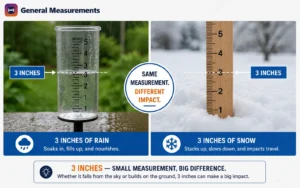
3 inches of rain is a lot for a single event. Weather services generally treat rainfall of 2 to 4 inches within 24 hours as heavy to extreme, often enough to prompt flood watches in low-lying or poorly drained areas. Consider that many U.S. cities only get 30 to 40 inches of rain across an entire year. Getting 3 inches in a single day means a meaningful chunk of a typical month’s rainfall showing up all at once.
3 inches of snow is a different story. It’s usually classified as light to moderate snowfall, enough to justify shoveling the sidewalk and slow down your commute, but rarely enough to shut down schools or highways on its own. That threshold tends to sit closer to 6 inches or more. Snow is also far less dense than rain, so 3 inches of snow contains much less actual water than 3 inches of rain. Depending on the type of snow, 3 inches might melt down to only about 0.3 inches of liquid.
3 Inches in DIY, Woodworking & Legal Contexts
Cutting material to exactly 3 inches. Mark your cut line from a fixed reference edge, use a square to keep it perpendicular, and cut just outside the line rather than right on it. Sanding down to the mark afterward tends to give a cleaner, more accurate result than trying to cut precisely on a pencil line the first time.
Screw and fastener sizing. A “3-inch screw” is measured from the tip to just under the head, not including the head itself. That matters when you’re figuring out how deep a screw will actually sit once it’s driven into material of a known thickness.
Knife blade length limits. In a number of U.S. states and cities, pocketknife blade length is regulated, and 3 inches is a common legal cutoff. Blades at or under roughly that length are often allowed for everyday carry without a special permit, while longer blades may not be. These laws vary quite a bit by state and even by city, so treat this as general background rather than legal advice, and check your local statute before carrying a knife of a specific length.
Where 3 Inches Shows Up in Real Life
- Shopping online. Knowing what a 3-inch item actually looks like keeps you from ordering something far smaller or larger than you pictured.
- Home improvement. Screws, hinges, pipe labeling, and tile spacers are frequently sized around 3 inches.
- First aid. Bandage strips and gauze rolls commonly come in 3-inch widths.
- Crafts and design. Cutting paper, fabric, or vinyl to precise small measurements.
- Weather tracking. Rainfall and snowfall totals are almost always reported in inches.
- Cooking and baking. Ramekins, cookie cutters, and small baking molds often come sized at 3 inches.
People Also Ask
How long is 3 inches in cm?
3 inches equals 7.62 centimeters. It’s the standard conversion wherever the metric system applies, and it comes in handy when you’re comparing product listings between U.S. and international stores.
Is 3 inches bigger than a credit card?
No. A standard credit card is 3.37 inches wide, so it’s a bit larger than 3 inches. Hold a credit card and mentally trim a little off one edge, and you’ve got a fairly accurate sense of 3 inches.
What common household items are 3 inches long?
A Post-it note, a hockey puck, a Band-Aid strip, and the short side of an index card are all easy-to-find, reliable references you probably already have around the house.
How many millimeters is 3 inches?
Exactly 76.2 millimeters (3 × 25.4 mm).
Is 3 inches considered small?
Depends on the context. For a phone screen, yes, that’s small. For a kitchen knife blade or a screw, 3 inches runs on the longer side. As a general object size, it’s compact enough to pocket but large enough to notice right away.
Quick FAQs
How do I measure 3 inches without a ruler?
Press three fingers together, use the edge of a Post-it note or index card, or fold a dollar bill in half. All of these get you close enough for a quick, tool-free estimate.
How far is 3 inches in real life?
It’s a short distance you can judge by eye without much trouble, roughly the width of a sticky note or the diameter of a hockey puck. Once you’ve seen a real reference, you won’t need to measure it again.
What does 3 inches of rain mean?
It signals a heavy single-day rainfall total, often enough to trigger flood watches in areas that don’t drain well. It’s a sizable chunk of many regions’ average monthly rainfall arriving in one go.
Is 3 inches the same as a quarter foot?
Yes. 3 inches is exactly one-quarter of a foot (12 ÷ 4 = 3), which is exactly why it lines up with the first quarter mark on a standard ruler.
Why do people confuse 3 inches with 3 square inches?
3 inches describes length, a single dimension. 3 square inches describes area, the size of a flat surface, like 1 inch by 3 inches, or any combination that multiplies out to 3. They’re not the same thing, and mixing them up is a common mistake when buying stickers, tiles, or fabric sold by area instead of length.
Why is 3 inches important to know?
It turns up constantly, in product dimensions, DIY projects, weather reports, and everyday tools. Once you’ve tied the number to a couple of real objects, estimating it stops requiring any tool at all.
Conclusion
The fastest way to actually feel how long 3 inches is: picture a Post-it note, a hockey puck, and a Band-Aid strip sitting side by side. You’ve almost certainly held all three, which makes them far more useful as mental anchors than a number like “7.62 cm” ever will be on its own.
And 3 inches shows up in places most guides never mention. A heavy rainfall total. A legal knife-length limit. The hinge on your own kitchen cabinet. Once you’ve connected the number to a handful of real, physical things, you won’t need a ruler to picture it again.