How Long Is 12 Inches? Real-World Comparisons to Visualize the Size
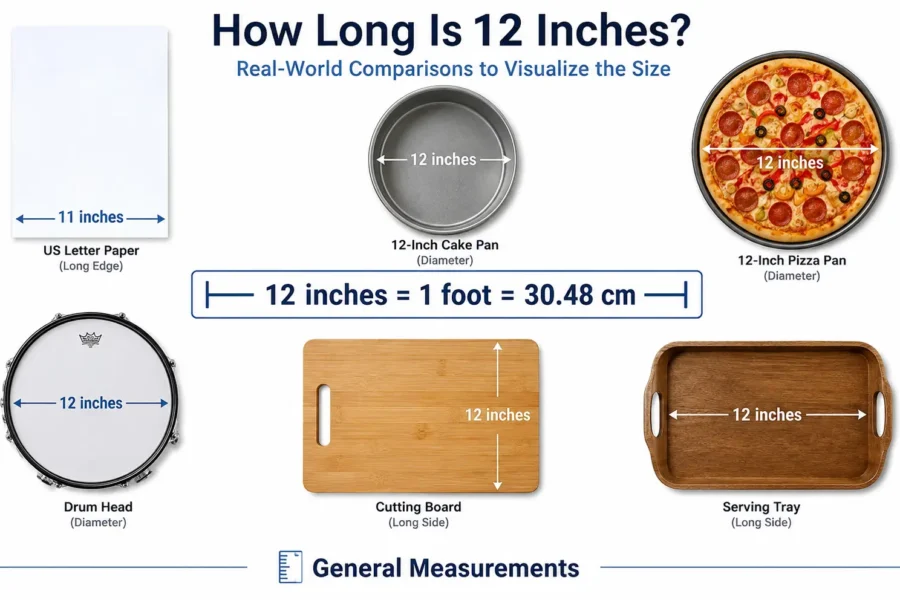
Twelve inches is easy to understand on paper, but harder to picture without a ruler in front of you. You may know that 12 inches equals one foot, yet that doesn’t necessarily tell you what a foot looks like in everyday life.
The easiest way to visualize it is to compare the measurement with familiar objects. From a standard sheet of paper to everyday household items, several references can help you develop a better sense of how long 12 inches really is.
Quick Answer: How Long Is 12 Inches?
12 inches is exactly 1 foot, which equals 30.48 centimeters or 304.8 millimeters. In everyday terms, you can picture it as a foot-long distance across a familiar object or dimension. Because many products vary in size, some comparisons are exact while others are only approximate.
12 Inches in Different Units
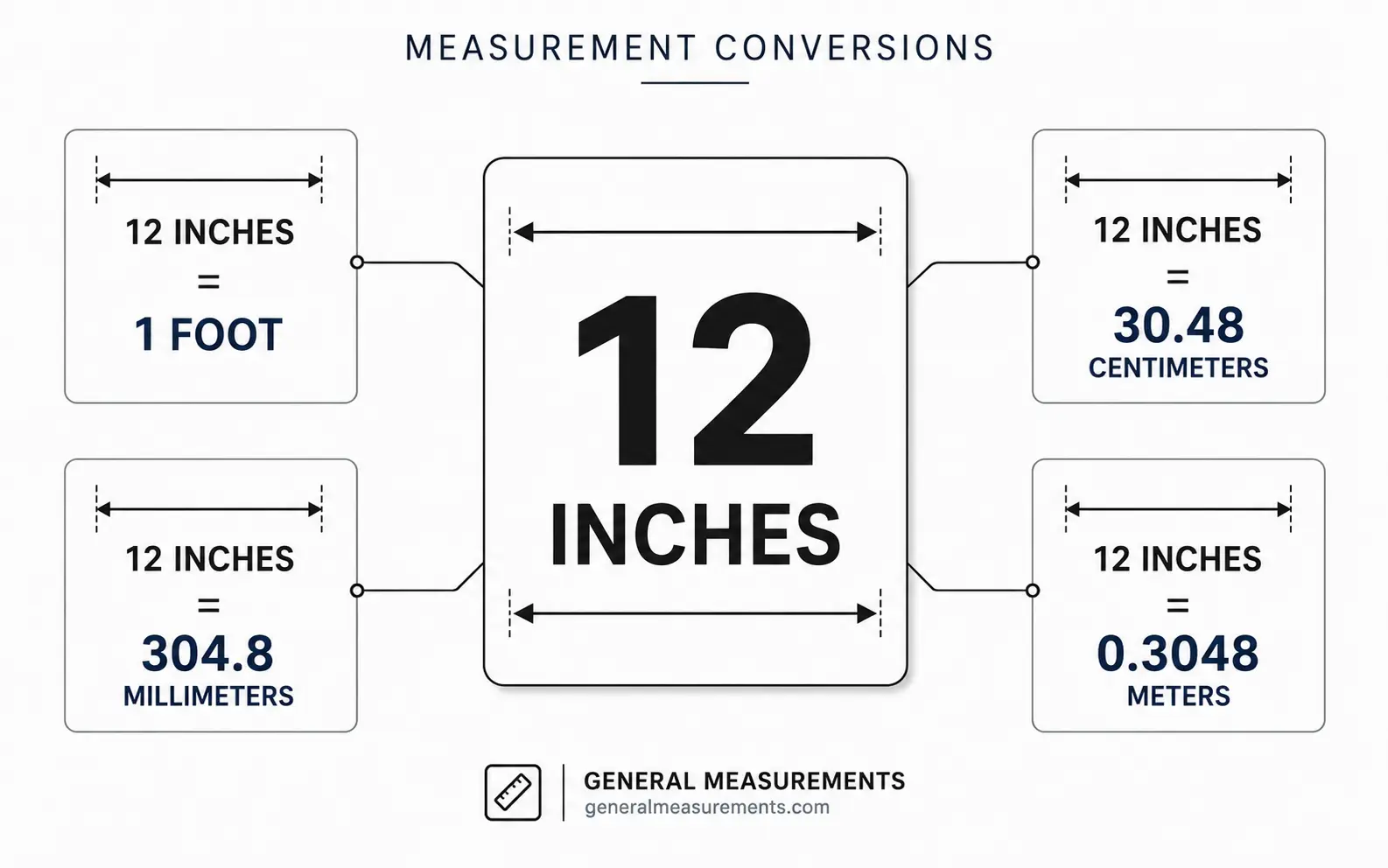
| Measurement | Equivalent |
|---|---|
| Inches | 12 inches |
| Feet | 1 foot |
| Centimeters | 30.48 cm |
| Millimeters | 304.8 mm |
| Meters | 0.3048 m |
| Yards | 0.3333 yd |
The conversion from inches to centimeters is exact because the international inch is defined as 2.54 centimeters. Therefore, 12 × 2.54 gives exactly 30.48 cm.
What Does 12 Inches Look Like?
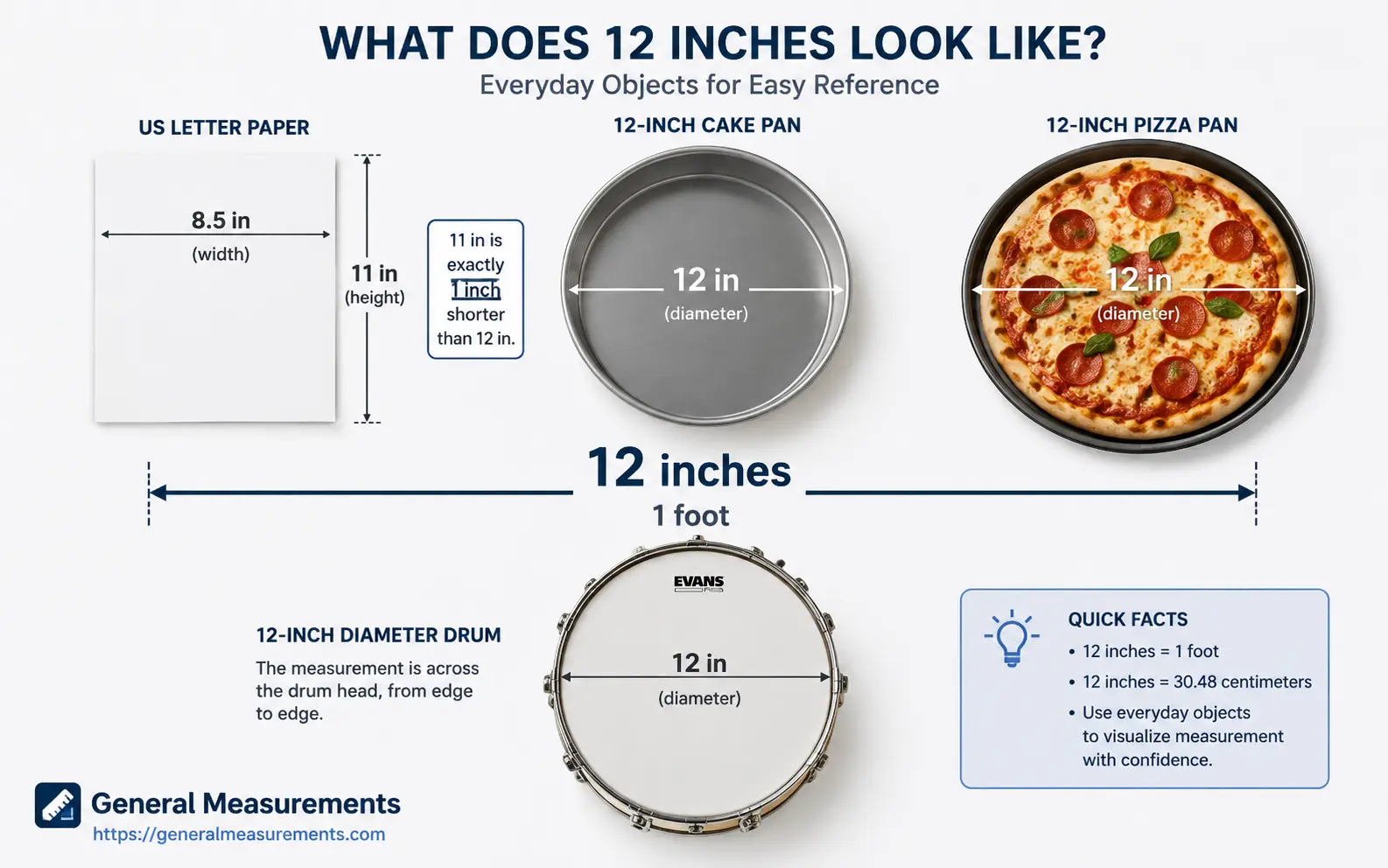
The easiest way to understand 12 inches is to compare the measurement with objects whose dimensions are known or commonly available in a similar size.
Here are several useful references:
| Object or Reference | Typical Dimension | How It Relates to 12 Inches |
|---|---|---|
| US Letter paper | 11 inches long | 1 inch shorter |
| 12-inch cake pan | 12 inches across | Very close to exact |
| Standard cutting board | Varies by model | Often around 12 inches wide |
| Large sketchbook | Varies by format | Some are close to 12 inches on one side |
| Desktop calendar page | Varies | Some formats approach 12 inches |
| 12-inch pizza pan | 12-inch nominal size | Close, but actual usable diameter varies |
| Large baking dish | Varies | Some models are around 12 inches long |
| Small serving tray | Varies | Some have a side close to 12 inches |
| Foot-long storage container | 12-inch nominal length | Close to one foot |
| Standardized 12-inch drum | 12-inch diameter | Exactly 12 inches across when specified by diameter |
The important thing is to check which dimension is being measured. A product described as “12 inches” may refer to its length, width, height, diameter, or another measurement.
10 Real-World Ways to Visualize 12 Inches
1. A US Letter Sheet Is About 1 Inch Shorter
A US Letter sheet measures 8.5 × 11 inches. Its long side is therefore exactly 1 inch shorter than 12 inches.
That makes Letter paper one of the most useful everyday references for visualizing a foot. If you place a 1-inch gap at the end of the long edge, the total distance becomes 12 inches.
This comparison is especially useful because Letter paper is common in offices, schools, and homes across the United States.
Accuracy: Very close, but not an exact 12-inch object.
2. A 12-Inch Cake Pan
A cake pan labeled 12 inches can provide a useful reference for the measurement, particularly when the specification refers to its diameter.
Imagine measuring straight across the center of a round 12-inch pan. That distance is approximately one foot.
Keep in mind that cookware measurements can be taken at different points, and the stated size may refer to the nominal diameter rather than the exact outside measurement.
Accuracy: Very close to exact when the specified dimension is 12 inches.
3. A 12-Inch Pizza Pan
A 12-inch pizza pan gives you another easy way to picture a one-foot distance across a circular object.
The important distinction is that a 12-inch pan is a nominal size, so its outside dimensions, inside cooking surface, and rim can differ. If you need a precise 12-inch distance, measure across the particular pan rather than relying only on its label.
Accuracy: Approximate to very close, depending on which part of the pan is measured.
4. A 12-Inch Drum
Drums are often identified by the diameter of their shells. A drum specified as 12 inches in diameter gives you a genuine circular reference for a one-foot measurement.
Unlike an object that merely happens to be close to 12 inches, this comparison is based on a stated diameter. That makes it particularly useful for understanding what 12 inches looks like as a straight-line distance across a circle.
Accuracy: Exact when the specified diameter is 12 inches.
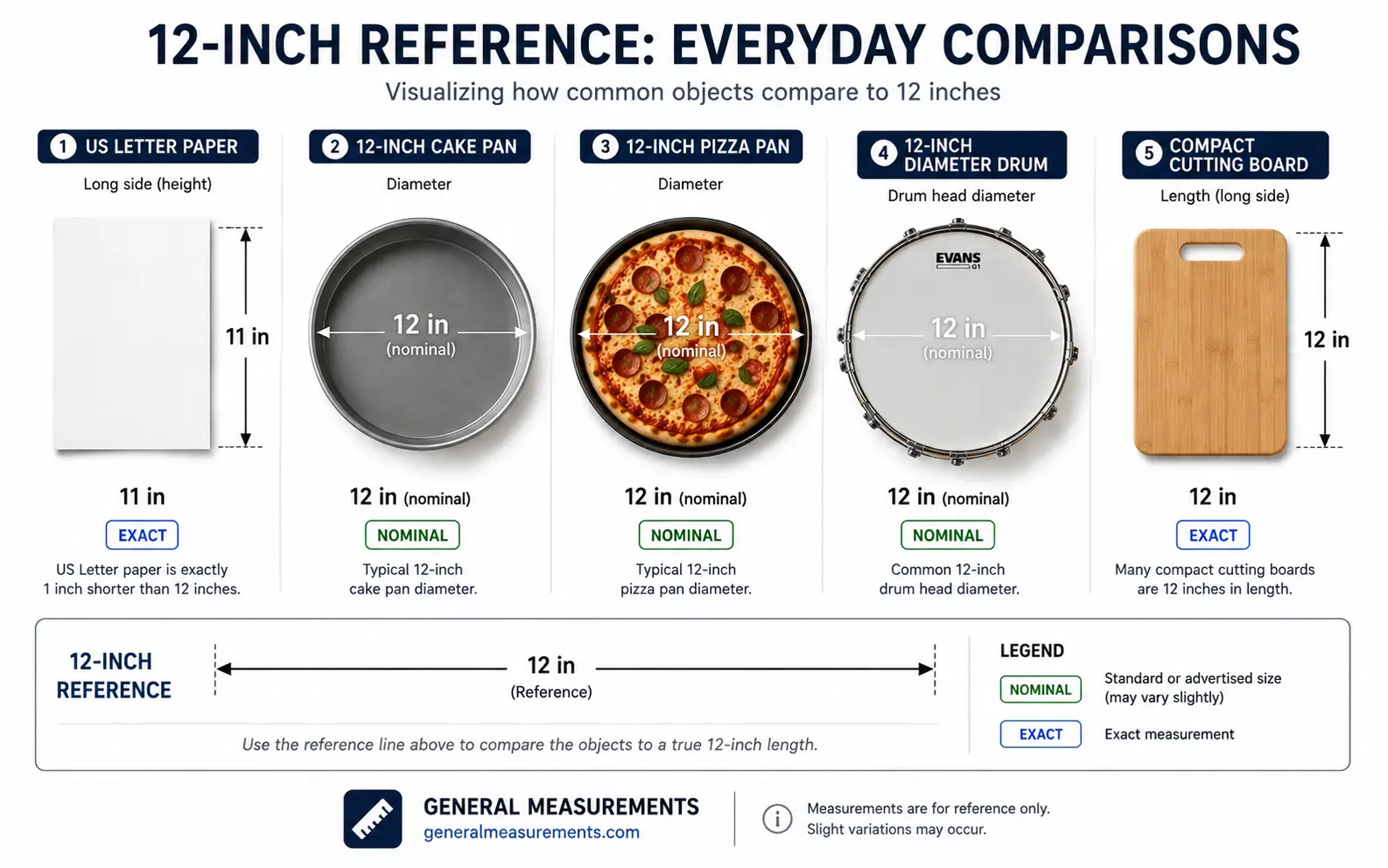
5. A Large Cutting Board
Cutting boards come in many dimensions, but 12 inches is a common scale for compact and medium kitchen boards.
A board that is approximately 12 inches wide can give you a practical visual reference because its flat edge makes the distance easy to imagine. However, always check the manufacturer’s listed dimensions before treating it as a precise measurement.
Accuracy: Variable.
6. A Small Serving Tray
Some small serving trays have a side measuring around 12 inches. Their rectangular shape makes them useful for visualizing a foot-long edge.
This comparison works best when the tray’s published dimensions actually show a 12-inch side. Don’t assume that every small tray is a foot long because tray sizes vary considerably.
Accuracy: Variable.
7. A Large Sketchbook
Sketchbooks are available in numerous formats, and some larger sizes have one dimension close to 12 inches.
This makes a large sketchbook a useful visual reference if you already own one. Check the dimensions printed on the packaging or product description, though, because “large” is not a standardized measurement.
Accuracy: Variable.
8. A Foot-Long Storage Container
Some storage containers are sold or described with a nominal length of around 12 inches.
A straight-sided container can be particularly easy to compare because you can place it beside another object and visually judge the difference. Just remember that nominal dimensions may not correspond exactly to the usable internal space.
Accuracy: Variable to very close, depending on the stated dimensions.
9. A Large Baking Dish
A number of baking dishes have a length close to 12 inches. Because baking dishes have clearly defined edges, they can be useful for developing a mental reference for a one-foot distance.
The exact measurement depends on the particular dish, so use the manufacturer’s dimensions if you need accuracy rather than estimating from its appearance.
Accuracy: Variable.
10. A Small Desktop Organizer
Some desktop organizers and document trays have a side close to 12 inches, making them another practical reference around a workspace.
This is more useful as a visual estimate than as a guaranteed measurement. Different organizer styles can have very different dimensions even when they look similar.
Accuracy: Variable.
Why Is 12 Inches Equal to One Foot?
A foot contains exactly 12 inches. This relationship is fixed, so there is no rounding involved.
That also makes 12 inches a particularly useful reference because it can be divided into several simple fractions:
- 6 inches = ½ foot
- 4 inches = ⅓ foot
- 3 inches = ¼ foot
- 2 inches = ⅙ foot
- 1 inch = ¹⁄₁₂ foot
The important distinction is between the mathematical definition of a foot and the dimensions of everyday products. A foot is exactly 12 inches, but an item labeled “12 inches” may use that number as a nominal product size.
How to Measure 12 Inches Without a Ruler
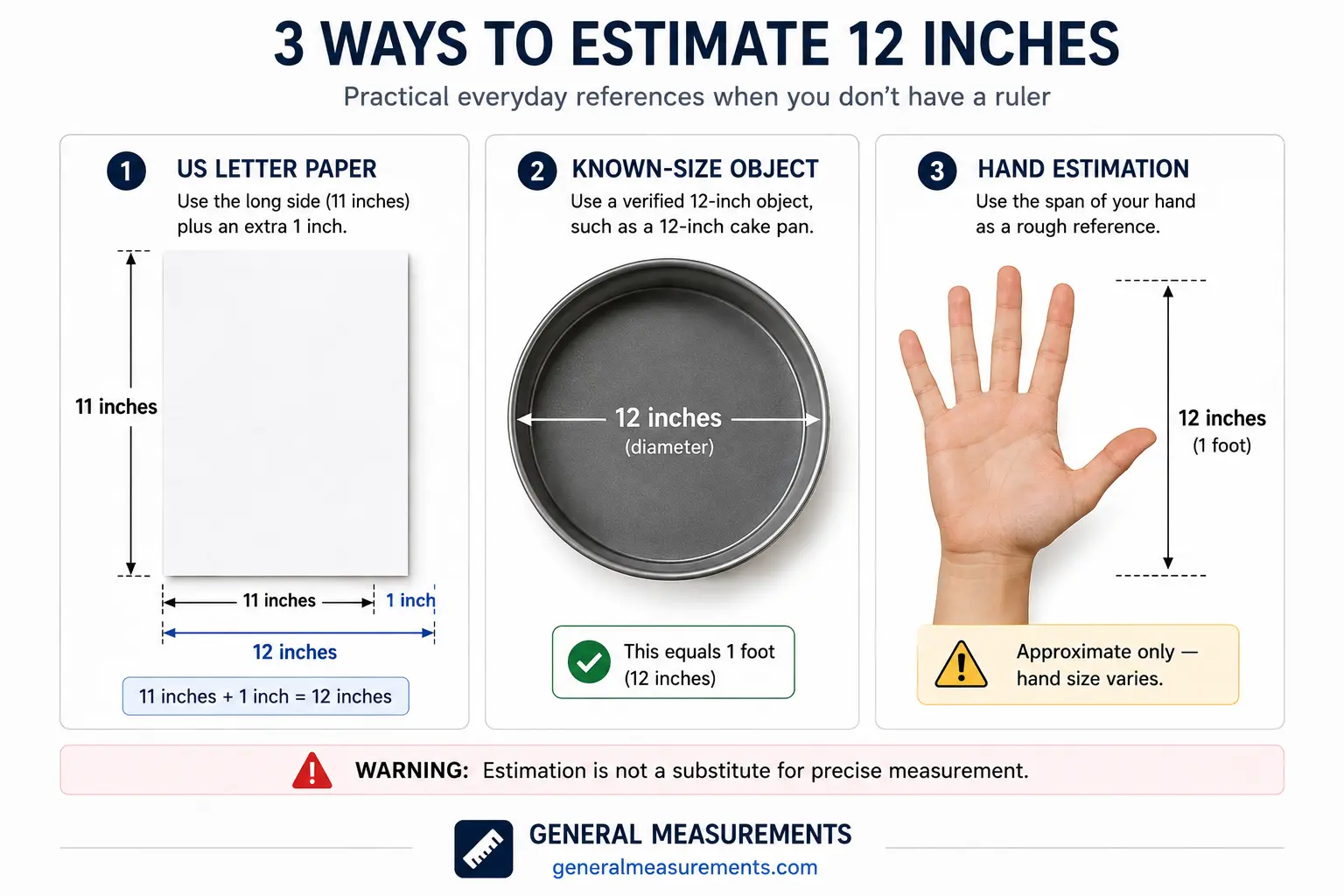
If you don’t have a ruler, you can still estimate one foot using familiar references. These methods are useful for quick checks, but they should not replace a measuring tool when precision matters.
Use US Letter Paper
The long side of US Letter paper is 11 inches, so it is exactly 1 inch shorter than a foot.
If you can accurately visualize or measure that extra inch, you can estimate 12 inches.
Use a Known 12-Inch Object
If you have a product with a documented 12-inch dimension, use it as your reference. A 12-inch pan or another object with a clearly stated measurement can provide a much better comparison than guessing from an object whose size varies.
Use a Printable Ruler
A printable ruler can be useful when you need a physical reference but don’t have a conventional ruler. However, make sure the document is printed at 100% scale and that your printer has not automatically resized the page.
Estimate With Your Hand
A hand can provide a rough reference, but hand dimensions vary significantly between people. Measure your own hand once if you want to use it for future estimates.
This method is suitable for approximation, not precision work.
Common Mistakes When Estimating 12 Inches
Confusing Inches With Centimeters
Twelve inches equals 30.48 cm, while 12 centimeters equals only about 4.72 inches. The two measurements are very different despite using the same number.
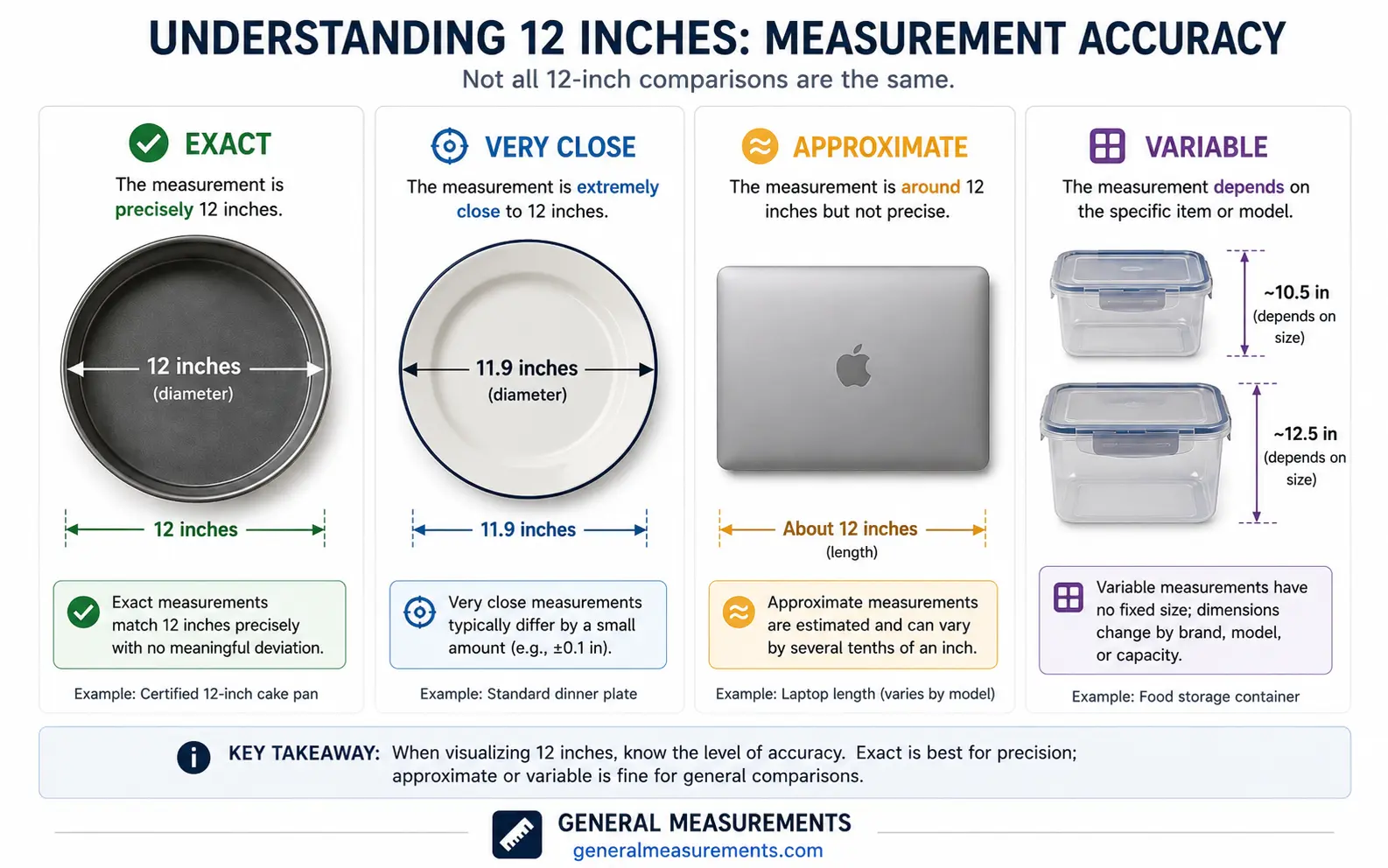
Assuming “12-Inch” Always Means Exactly 12 Inches
Product labels often use nominal measurements. A product advertised as 12 inches may have a slightly different outside dimension, depending on what the manufacturer uses as the reference point.
Measuring the Wrong Dimension
Always check whether the stated measurement refers to:
- Length
- Width
- Height
- Diameter
- Circumference
A 12-inch diameter and a 12-inch circumference are completely different measurements.
Relying on Visual Estimates for Precision Work
A comparison object can help you understand a measurement, but visual estimation is not a substitute for a calibrated ruler or measuring tape when accuracy matters.
12 Inches Compared With Other Common Measurement
Understanding nearby measurements can make one foot easier to visualize.
| Measurement | Relationship to 12 Inches |
|---|---|
| 3 inches | ¼ of 12 inches |
| 6 inches | ½ of 12 inches |
| 9 inches | ¾ of 12 inches |
| 12 inches | 1 foot |
| 18 inches | 1.5 times 12 inches |
| 24 inches | 2 feet, or twice 12 inches |
| 36 inches | 3 feet, or 3 times 12 inches |
For example, 24 inches is exactly twice as long as 12 inches, while 6 inches is exactly half as long.
Another useful comparison is a yard. Since a yard contains 36 inches, 12 inches represents exactly one-third of a yard.
Is 12 Inches a Long or Short Measurement?
It depends on what you’re measuring.
For a piece of paper, kitchen pan, small tray, or compact household item, 12 inches can represent a substantial dimension. For furniture, walls, doors, or rooms, one foot is relatively small.
The measurement itself isn’t inherently “big” or “small.” Its practical significance depends on the object and the dimension being measured.
Frequently Asked Questions About 12 Inches
Is 12 inches exactly 1 foot?
Yes. 12 inches is exactly 1 foot. This is a fixed measurement relationship, so there is no rounding involved.
How many centimeters are 12 inches?
12 inches equals exactly 30.48 centimeters. The conversion uses the defined relationship of 1 inch = 2.54 centimeters.
What does 12 inches look like?
Twelve inches is about the length of a foot. You can visualize it using a known 12-inch object, such as an item with a documented 12-inch diameter or length, or by comparing it with an 11-inch-long sheet of US Letter paper.
How long is 12 inches compared with a foot?
They are exactly the same length. One foot equals 12 inches.
Is 12 inches the same as 12 centimeters?
No. Twelve inches equals 30.48 cm, while 12 centimeters equals approximately 4.72 inches.
How can I measure 12 inches without a ruler?
You can estimate it using a known-size object, US Letter paper, a correctly scaled printable ruler, or a measurement reference you have already verified. These methods provide estimates unless the reference itself has a known precise dimension.
Is a 12-inch object always exactly 12 inches?
No. Some products use 12 inches as a nominal size, while others have a specific dimension that is actually 12 inches. Check which part of the product the measurement describes.
What is half of 12 inches?
Half of 12 inches is 6 inches, which is also half a foot.
Final Thoughts
Twelve inches is exactly one foot, but the number becomes much easier to understand when you connect it to something you can actually see or hold.
A US Letter sheet gives you an object that is exactly one inch shorter than 12 inches, while a properly specified 12-inch pan or drum can provide a closer direct reference. For variable household items, always check their actual dimensions rather than assuming the label tells the whole story.
Once you have a few reliable reference points in mind, 12 inches stops being an abstract number and becomes a distance you can recognize in everyday situations.
Related Articles
Craftsman Drill/Driver 3/8-Inch 7-Amp: Full Size and Specs Guide
If you searched for the craftsman drill/driver 3/8-inch 7-amp, you are probably trying to figure out exactly what you are buying before you spend the money. The name…
How Long Is 7 Inches? 18 Common Things That Are 7 Inches Long
Somebody tells you a laptop bag fits a 7 Inches tablet, or a recipe calls for a 7-inch cake pan, and you’re left doing mental math with no…
18 Common Things That Are Exactly 3 Inches Long
You’re looking at a product listing, a recipe, or a weather report, and it just says 3 inches. Without a ruler nearby, that number doesn’t really mean much.…