How Big Is a Basketball Court? Compared to Other Sports Fields
Closest match: 25-ft tape measure is 0.00× Basketball court (94 ft).
Quick compare: AirPods charging case 0.00× · 25-ft tape measure 0.00×
A regulation basketball court measures between 84 feet and 94 feet long, depending on the league. NBA and NCAA courts are the largest at 94 x 50 feet (28.65 x 15.24 m), while FIBA international courts measure 91.86 x 49.21 feet (28 x 15 m), and high school courts are the smallest at 84 x 50 feet.
That single answer, however, only tells part of the story. Court size changes at every level of play, and it also changes dramatically when you compare basketball to other sports. In this guide, we’ll break down exact dimensions for every major basketball league, explain why these differences exist, and compare a basketball court against tennis, volleyball, netball, and football pitches so you can see exactly how it stacks up.
Basketball Court Size Comparison Table
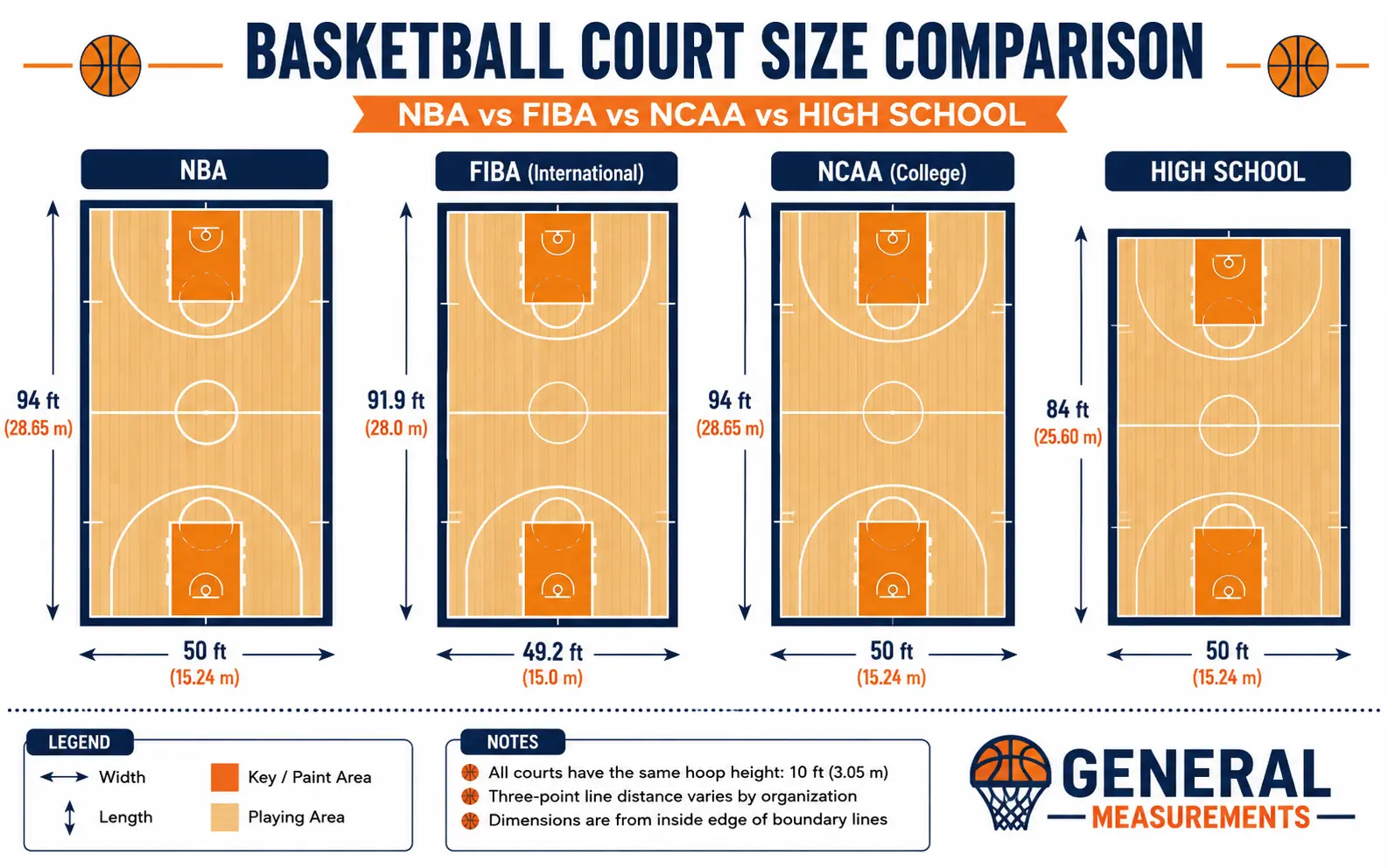
Before diving into the details, here’s a quick side-by-side comparison of the four major basketball standards. Use this table as a fast reference, then scroll down for a full breakdown of each measurement.
| Measurement | NBA | FIBA (International) | NCAA | High School |
|---|---|---|---|---|
| Court Length | 94 ft (28.65 m) | 91.86 ft (28 m) | 94 ft (28.65 m) | 84 ft (25.6 m) |
| Court Width | 50 ft (15.24 m) | 49.21 ft (15 m) | 50 ft (15.24 m) | 50 ft (15.24 m) |
| Key/Paint Width | 16 ft (4.88 m) | 16.08 ft (4.9 m) | 12 ft (3.66 m) | 12 ft (3.66 m) |
| 3-Point Line | 23.75 ft top / 22 ft corners (7.24 m / 6.70 m) | 22.15 ft (6.75 m) | 22.15 ft (6.75 m) | 19.75 ft (6.02 m) |
| Free-Throw Line | 15 ft (4.57 m) | 15.09 ft (4.6 m) | 15 ft (4.57 m) | 15 ft (4.57 m) |
| Center Circle Diameter | 12 ft (3.66 m) | 11.81 ft (3.6 m) | 12 ft (3.66 m) | 12 ft (3.66 m) |
| Hoop Height | 10 ft (3.05 m) | 10 ft (3.05 m) | 10 ft (3.05 m) | 10 ft (3.05 m) |
As the table shows, hoop height never changes. However, nearly everything else does, from the length of the court to the width of the key. Let’s look at each measurement individually.
How Long and Wide Is a Basketball Court?
An NBA or NCAA court runs 94 feet long and 50 feet wide. FIBA courts are slightly shorter at 91.86 feet, while high school courts are the most compact at 84 feet long.
This 10-foot difference between high school and professional courts might seem small, but it changes the game significantly. A shorter court means less distance to cover on fast breaks, therefore transition plays develop more quickly at the high school level. Meanwhile, NBA and NCAA players need greater endurance simply because they cover more ground over the course of a game.
Width stays fairly consistent across US leagues at 50 feet. FIBA is the outlier here too, using a slightly narrower 49.21-foot width to fit its metric-based 15-meter standard.
How Wide Is the Key (Paint) on a Basketball Court?
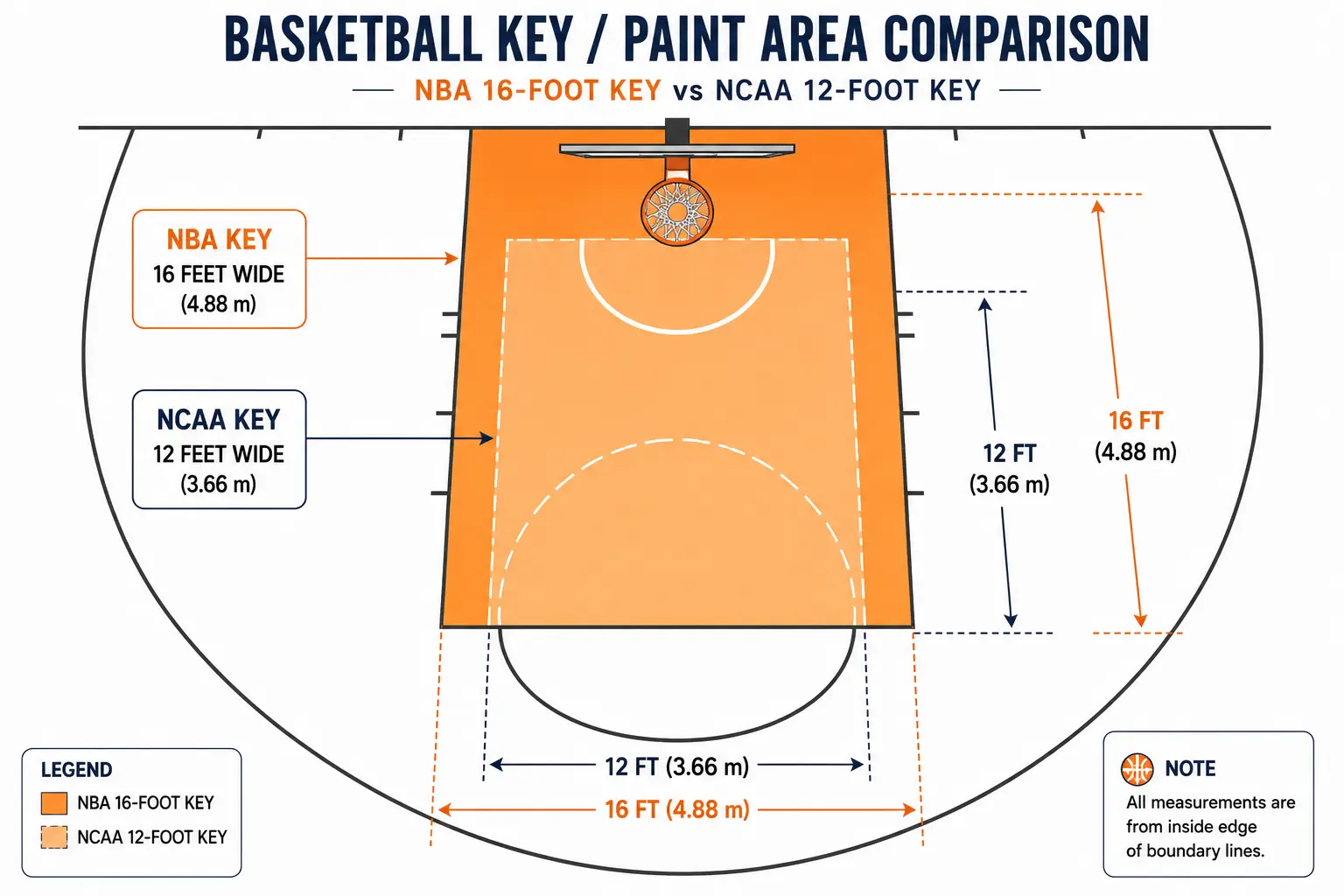
The key, also called the paint or free-throw lane, is 16 feet wide in the NBA and FIBA but narrows to just 12 feet in NCAA and high school basketball.
This four-foot difference has a major tactical impact. A wider key, like the NBA’s, pushes big men further from the basket and opens driving lanes for guards. In contrast, a narrower key crowds the area under the hoop, which favors physical post play and makes rebounding position more contested. The key’s depth, however, stays constant at 19 feet (5.8 m) from the baseline to the free-throw line across nearly every level.
How Far Is the Three-Point Line?
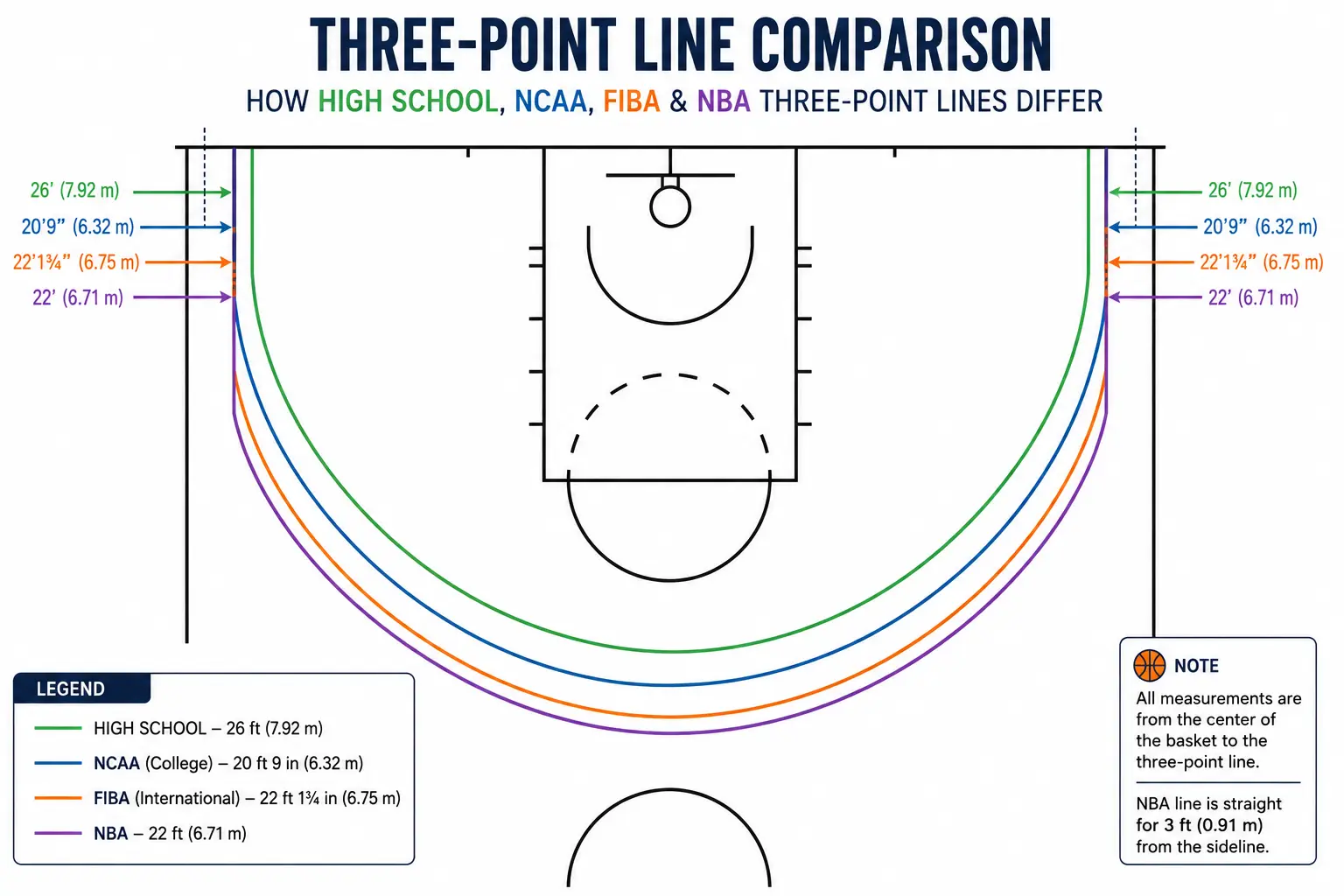
The three-point line varies more than any other basketball court measurement. It ranges from 19.75 feet in high school to 23.75 feet at the top of the arc in the NBA.
Here’s the full breakdown:
- High school: 19.75 ft (6.02 m) uniformly around the arc
- NCAA: 22.15 ft (6.75 m), extended to the international distance in 2019-20 (men) and 2020-21 (women)
- FIBA/WNBA: 22.15 ft (6.75 m)
- NBA: 22 ft (6.70 m) in the corners, extending to 23.75 ft (7.24 m) at the top of the arc
The NBA is unique because its three-point line isn’t a single consistent arc. Instead, it straightens out near the corners, creating a shorter shot there than at the top of the key. As a result, “corner threes” are among the most efficient shots in professional basketball, since players give up very little distance for the same three points.
How Far Is the Free-Throw Line?
Every major basketball league places the free-throw line 15 feet from the backboard, give or take a few inches for metric rounding. FIBA measures it at 4.6 m (15.09 ft), while NBA, NCAA, and high school courts all use exactly 15 ft (4.57 m).
This consistency makes free-throw shooting one of the few skills that transfers directly between levels of play. A player who masters the free-throw stripe in high school won’t need to relearn the distance in college or the pros.
How Big Is the Center Circle?
The center circle, where the game begins with a jump ball, has a diameter of roughly 12 feet across most leagues. NBA, NCAA, and high school courts use exactly 12 ft (3.66 m), while FIBA’s circle is marginally smaller at 11.81 ft (3.6 m).
Unlike the key or three-point line, the center circle’s size doesn’t affect strategy much beyond the opening tip-off. It mainly exists to define a fair, neutral zone for the jump ball.
Why Do Basketball Court Dimensions Vary?
Court dimensions aren’t arbitrary. Each governing body adjusts measurements to match the physical development and skill level of its players, and this has a real impact on how the game is played.
- Smaller courts favor speed and contact. High school courts pack players into a tighter space, which increases physical contact and rewards quick decision-making over pure athleticism.
- Larger courts reward conditioning and spacing. NBA and NCAA courts demand better cardiovascular fitness, since players cover more distance across 94 feet.
- A wider key opens driving lanes. The NBA’s 16-foot key creates more room for guards to attack the basket, while the NCAA’s narrower 12-foot key compresses the paint and favors interior scoring.
- A deeper three-point line rewards elite shooters. As the arc moves further from the basket, from high school to the NBA, three-point shooting becomes a rarer, more specialized skill rather than a routine part of every player’s game.
In short, court size is one of the quiet forces shaping how basketball is played at every level, even though most fans never think about it during a game.
Half-Court and Other Basketball Court Variants
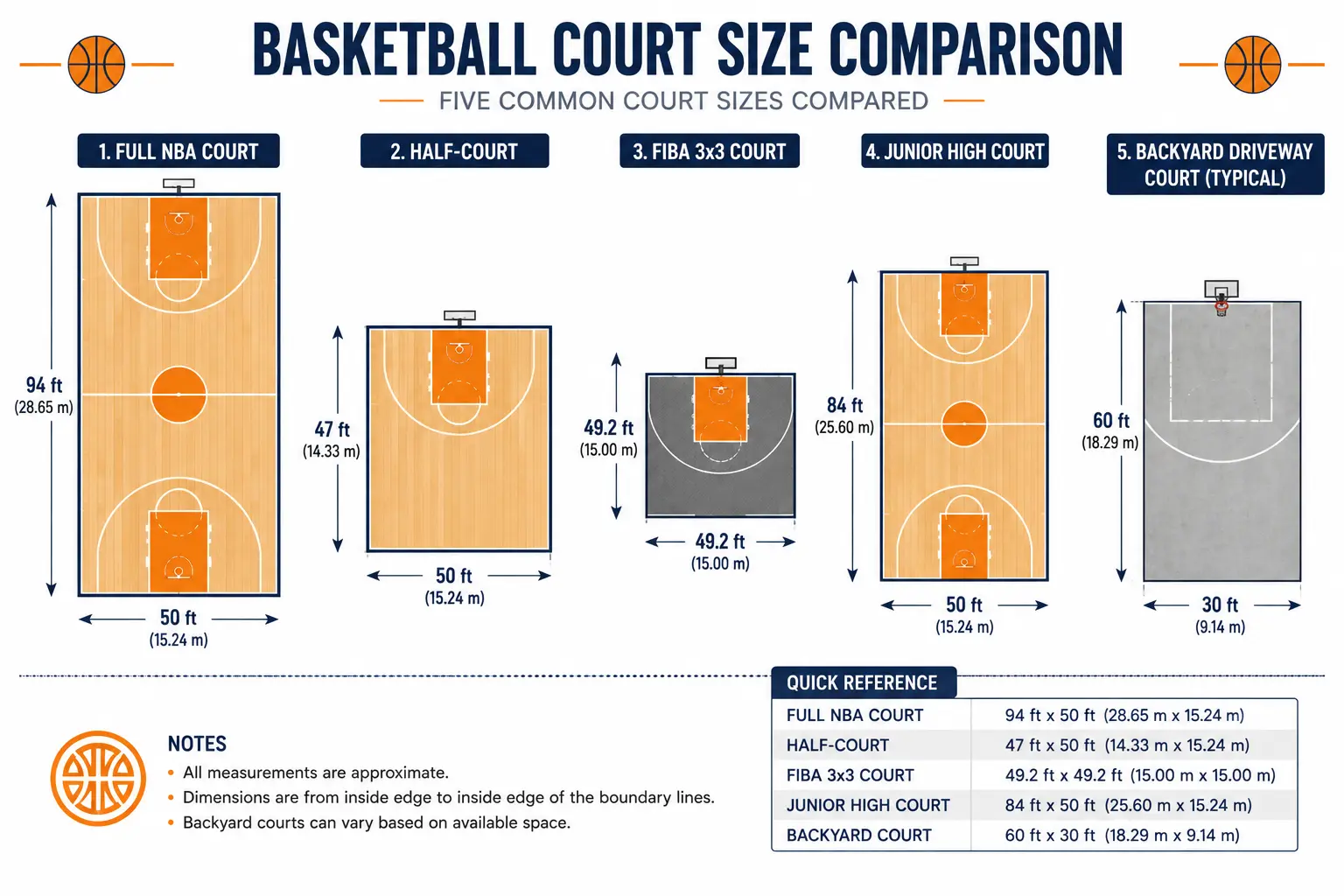
Not every court used for basketball is full-sized. Several smaller formats exist for training, recreational play, and youth basketball.
| Court Type | Dimensions (Feet) | Dimensions (Metres) |
|---|---|---|
| NBA Half-Court | 47 x 50 ft | 14.33 x 15.24 m |
| High School Half-Court | 42 x 50 ft | 12.8 x 15.24 m |
| FIBA 3×3 Court | 36 x 49 ft | 11 x 15 m |
| Junior High Court | 74 x 42 ft | 22.56 x 12.8 m |
| Backyard/Driveway Court | 30 x 50 ft (typical) | 9.14 x 15.24 m (typical) |
FIBA 3×3, basketball’s fast-growing half-court format, uses a single hoop and a compact 11 x 15 m surface. Meanwhile, most home courts fall well short of regulation size, which is perfectly fine for recreational play as long as the key markings and hoop height stay accurate for realistic practice.
Basketball Court Size Compared to Other Sports Fields
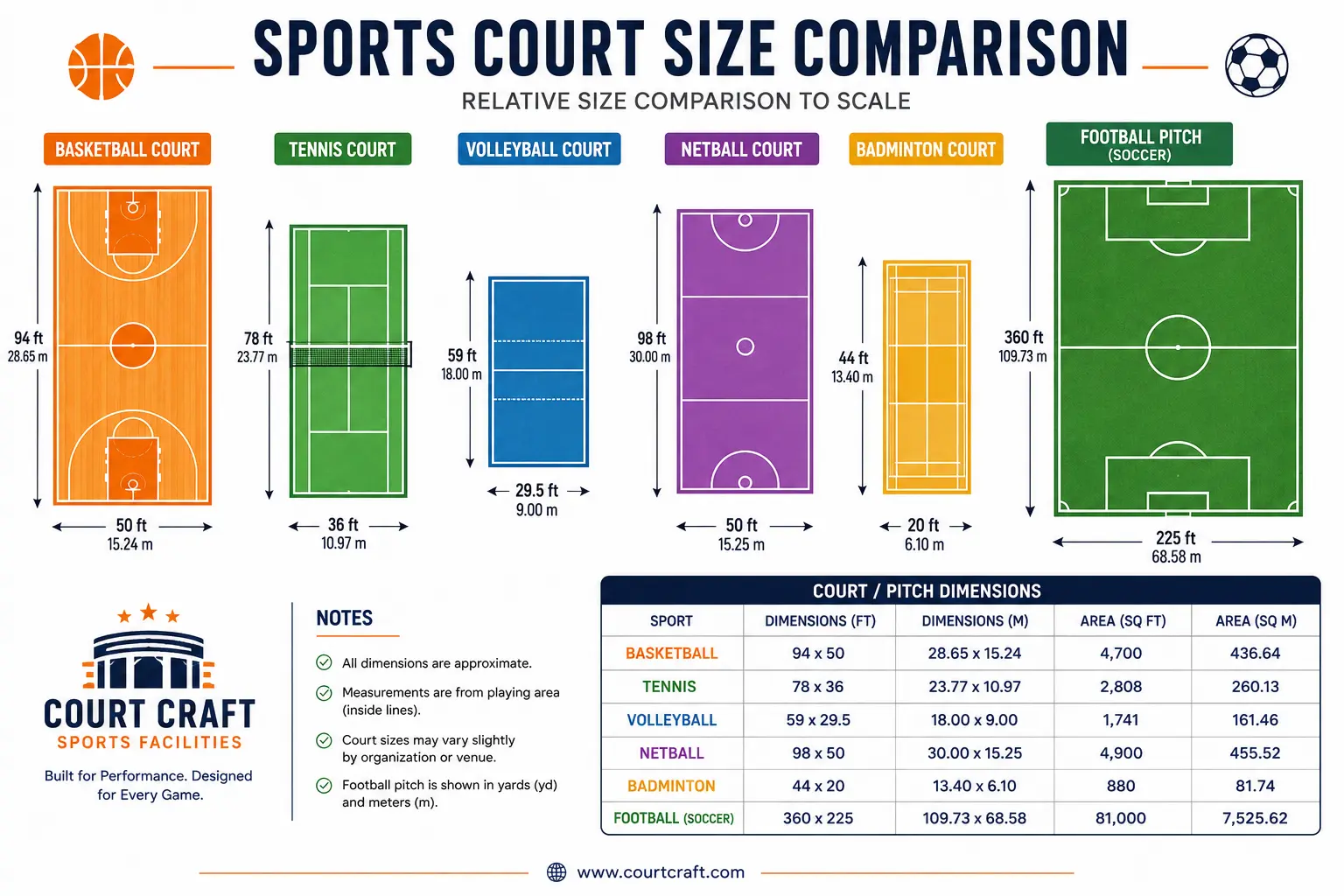
Basketball courts are relatively compact compared to most outdoor pitches, but they’re larger than many indoor court sports. Here’s how a regulation FIBA basketball court (28 x 15 m) stacks up against other common sports surfaces.
| Sport | Playing Area (Metres) | Playing Area (Feet) |
|---|---|---|
| Basketball (FIBA) | 28 x 15 m | 91.86 x 49.21 ft |
| Tennis (doubles) | 23.77 x 10.97 m | 78 x 36 ft |
| Volleyball | 18 x 9 m | 59 x 29.5 ft |
| Netball | 30.5 x 15.25 m | 100 x 50 ft |
| Badminton (doubles) | 13.4 x 6.1 m | 44 x 20 ft |
| Handball | 40 x 20 m | 131 x 65.6 ft |
| Football (soccer) pitch | 105 x 68 m (typical) | 344 x 223 ft (typical) |
A basketball court is roughly three times the size of a badminton court, yet it’s only about a fifth of the size of a full football pitch. Netball is the closest comparison in terms of footprint, since both sports use a similarly proportioned rectangular court, though netball’s is slightly longer.
This size range matters most for facility planners. A multi-sport hall built to basketball dimensions can typically accommodate volleyball, netball, badminton, and even mini-tennis with additional line markings, since basketball’s footprint comfortably contains all of them. Football, by contrast, requires a completely separate outdoor space due to its far larger scale.
Frequently Asked Questions
How big is a basketball court in feet?
An NBA or NCAA court measures 94 x 50 feet. FIBA international courts are 91.86 x 49.21 feet, and high school courts measure 84 x 50 feet.
How big is a basketball court in meters?
NBA and NCAA courts measure 28.65 x 15.24 m. FIBA courts measure 28 x 15 m, the standard used in most countries outside the US.
Is an NBA court the same size as an NCAA court?
Yes, NBA and NCAA courts share the same 94 x 50 ft dimensions. However, they differ in key width, since the NBA uses a 16-foot key while the NCAA uses a narrower 12-foot key.
What is the smallest regulation basketball court?
High school courts, at 84 x 50 feet, are the smallest full-size regulation courts. FIBA 3×3 courts are smaller still at 11 x 15 m, but they’re designed for half-court, three-on-three play rather than the traditional full game.
Why is the NBA three-point line different in the corners?
The NBA’s three-point arc straightens out near the sidelines, placing the corner three-point line at 22 feet instead of 23.75 feet at the top of the key. This design keeps the line a fixed distance from the sideline while still creating a full arc elsewhere.
How much space do you need around a basketball court?
Most guidelines recommend at least 10 feet of clear perimeter space on all sides of a basketball court for player safety and out-of-bounds movement, in addition to the playing surface itself.