Standard SIM card Size in mm & Inches
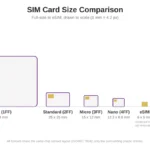
Standard SIM card Size in mm & Inches measures 25.0mm × 15.0mm × 0.8mm. It weighs about 1.0g.
Dimensions
| Length | 25.0 mm |
|---|---|
| Width | 15.0 mm |
| Height | 0.8 mm |
| Weight | 1.0 g |
How Big Is a SIM Card? Dimensions Compared to Everyday Items
Nearly everyone who’s owned a smartphone has fumbled with a SIM card tray at some point, usually while squinting at a tiny plastic rectangle trying to figure out if it’s the right size. What most guides skip is that “SIM card” isn’t one fixed size at all. It’s a family of four physical formats, each one smaller than the last, plus a fifth option that isn’t a physical card in the first place.
Below you’ll find the exact dimensions for every SIM format still in use, the official standard behind them, and a set of everyday comparisons that make the size easier to picture.
Quick Answer: How Big Is a SIM Card?
The standard SIM card (also called mini SIM or 2FF) measures 25 mm x 15 mm x 0.76 mm and weighs approximately 0.5 to 1 gram. But if someone hands you “a SIM card” today, it’s far more likely to be a nano SIM, the current default at just 12.3 mm x 8.8 mm x 0.67 mm.
SIM Card Dimensions at a Glance
| Format | Width x Height | Thickness | Also Known As | Introduced |
|---|---|---|---|---|
| Full-size SIM | 85.60 x 53.98 mm | 0.76 mm | 1FF | 1991 |
| Standard (Mini) SIM | 25 x 15 mm | 0.76 mm | 2FF, ID-000 | 1996 |
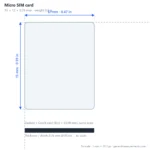
| Micro SIM | 15 x 12 mm | 0.76 mm | 3FF | 2003 |
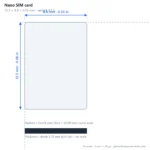
| Nano SIM | 12.3 x 8.8 mm | 0.67 mm | 4FF | 2012 |
| eSIM | 6 x 5 mm | ~1 mm | Embedded SIM | 2016 |
Every format down to nano SIM carries the exact same gold contact chip and electrical layout, defined by ISO/IEC 7816. Only the plastic carrier around the chip gets smaller with each generation. The eSIM breaks that pattern entirely: it’s a soldered chip with no removable plastic at all.
What Does a Standard SIM Card Look Like in Size?
Picture a small rectangle about the size of a postage stamp, with one corner clipped at an angle so it can only be inserted one way. At 25 x 15 mm, the standard (mini) SIM is roughly a third the length of a credit card and noticeably narrower too.
If you’ve ever seen a “combi SIM” or “triple cut SIM” at a phone store, that’s a single piece of plastic sized like a full ID-1 card (85.6 x 53.98 mm) with the mini, micro, and nano outlines pre-scored inside it. You punch out whichever size your device actually needs, and the leftover plastic frame gets thrown away.
6 Everyday Comparisons That Help Visualize a SIM Card
Numbers on a spec sheet don’t always translate to a mental picture. Here’s how the different SIM sizes compare to things you probably already have nearby.
1. A US Quarter
A US quarter is about 24.3 mm across, almost exactly the same length as a standard SIM card’s 25 mm long edge, though the SIM is rectangular rather than round.
Comparison: Nearly identical length.
2. A Postage Stamp
A standard US postage stamp measures roughly 25 x 22 mm, close in length to a standard SIM but noticeably wider. A nano SIM, on the other hand, would fit inside a stamp’s outline with room to spare.
Comparison: Similar length, stamp is wider.
3. A Fingernail
An adult thumbnail typically runs 12 to 15 mm wide, remarkably close to a nano SIM’s 12.3 mm width. It’s part of why nano SIMs are so easy to lose: you can genuinely cover one with a single fingertip.
Comparison: About the same width as a thumbnail.
4. A Credit Card
A credit card (ISO/IEC 7810 ID-1) measures 85.6 x 53.98 mm, more than three times the length and width of a standard SIM. Interestingly, the very first SIM card format, the full-size or 1FF, was exactly this size before the industry started shrinking things down.
Comparison: Full-size SIM matches; modern SIMs are much smaller.
5. An SD Card
A full-size SD card measures 32 x 24 mm, larger than every SIM format, including the standard one. A micro SD card, at 15 x 11 mm, lands almost exactly between micro SIM and nano SIM in size, which is a handy mental anchor if you’ve ever handled camera memory cards.
Comparison: SD card is larger than a SIM; microSD is close to micro/nano SIM.
6. An AA Battery
An AA battery is about 14.5 mm in diameter. That’s very close to a micro SIM’s 12 mm width and just a touch larger than a nano SIM’s 8.8 mm width, useful if you’re trying to eyeball SIM size against something round instead of flat.
Comparison: Diameter close to micro/nano SIM width.
Every SIM Card Size, Explained
Full-size SIM (1FF), 85.60 x 53.98 mm. Introduced in 1991 by Munich smart card maker Giesecke & Devrient, the very first SIM cards were literally credit card sized, since early mobile phones had plenty of room to spare. This format is now obsolete as a card you’d actually carry, but its shape survives as the outer frame of modern combi SIM cards.
Standard or Mini SIM (2FF), 25 x 15 mm. Introduced in 1996, this became the SIM card most people picture when they hear the term, even though it hasn’t shipped in a mainstream phone in well over a decade. It’s officially designated ID-000 under ISO/IEC 7810, with a corner bevel and a thickness tolerance of 0.68 to 0.84 mm. It still shows up in some older feature phones, industrial equipment, and legacy routers.
Micro SIM (3FF), 15 x 12 mm. Introduced in 2003 but not widely adopted until the iPhone 4 in 2010, the micro SIM trimmed away plastic around the same chip used in the mini SIM. It’s mostly gone from phones today but still turns up in some mobile broadband routers and older tablets.
Nano SIM (4FF), 12.3 x 8.8 mm. Debuting with the iPhone 5 in 2012, the nano SIM strips the plastic border down to almost nothing beyond what’s needed to hold the chip securely. It’s the current standard across the vast majority of smartphones that still use a physical SIM tray.
eSIM, roughly 6 x 5 mm. Not a removable card at all. An eSIM is a small chip soldered directly onto a device’s circuit board, holding the same kind of subscriber data as a physical SIM but programmed remotely over the air. Freeing up the internal space a SIM tray would otherwise need is a big part of why manufacturers have pushed for it, since that space can go toward a larger battery or better water resistance instead. Several current flagship phones sold in the US, including recent iPhones and select Pixel and Galaxy models, have dropped the physical tray entirely in favor of eSIM only.
How Big Is a SIM Card in Centimeters?
For anyone thinking in metric:
- Standard SIM: 2.5 x 1.5 cm
- Micro SIM: 1.5 x 1.2 cm
- Nano SIM: 1.23 x 0.88 cm
- eSIM chip: about 0.6 x 0.5 cm
All figures are for the card or chip itself, not including any packaging or the punch-out frame it may ship inside.
How Much Does a SIM Card Weigh?
This is a detail almost no source publishes an official figure for, since SIM card manufacturers don’t typically list weight on a spec sheet the way they do for phones or batteries. Based on the card’s PVC plastic construction and thin gold contact layer, a standard SIM card weighs somewhere in the range of 0.5 to 1 gram, with smaller formats like micro and nano SIM weighing less simply because there’s less plastic surrounding the same chip. Treat this as a reasonable estimate rather than a manufacturer-certified number.
The Standard Behind SIM Card Sizes: ISO/IEC 7810
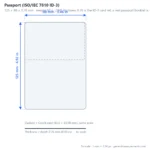
SIM card dimensions aren’t arbitrary. The mini SIM’s 25 x 15 mm footprint is formally defined as the ID-000 format under ISO/IEC 7810, the same international standard that governs credit card size (ID-1), older ID card formats (ID-2), and passport data pages (ID-3). The standard also sets a shared thickness tolerance of 0.68 to 0.84 mm across card formats, along with rules for corner rounding and dimensional stability under normal handling.
Micro and nano SIM aren’t separately defined under ISO/IEC 7810 in the same way. They’re industry form factor specifications built around the same ID-000 chip module, just with progressively less plastic carrier around it.
Common Mistakes When Comparing SIM Card Sizes
Mistake 1: Assuming “standard SIM” means the most common one. It’s actually the least common format in phones sold today. Nano SIM is now the default.
Mistake 2: Confusing the chip size with the card size. The gold contact chip is identical across full-size down to nano SIM. Only the surrounding plastic shrinks.
Mistake 3: Trimming a SIM to the wrong size. Cutting a mini or micro SIM down to nano SIM at home risks slicing into the chip itself if measurements are off by even a millimeter.
Mistake 4: Treating eSIM as just another physical size. It isn’t removable at all, and there’s no adapter that converts a physical SIM into an eSIM or vice versa.
Frequently Asked Questions
How big is a standard SIM card?
25 mm x 15 mm x 0.76 mm, officially the ID-000 format under ISO/IEC 7810.
How big is a nano SIM?
12.3 mm x 8.8 mm x 0.67 mm, the smallest removable SIM format and the current standard in most smartphones.
How big is a micro SIM?
15 mm x 12 mm x 0.76 mm, one size up from nano SIM.
How big is an eSIM?
Roughly 6 mm x 5 mm and about 1 mm thick, though it’s a soldered chip rather than a removable card, so it’s never handled directly.
How much does a SIM card weigh?
There’s no official manufacturer figure, but a standard SIM likely weighs around 0.5 to 1 gram based on its size and material.
Are all SIM card sizes compatible with an adapter?
You can adapt a smaller SIM up to fit a larger tray (nano into a micro or standard slot), but not the other way around, since a larger card physically can’t fit into a smaller slot without being cut down.
Final Takeaway
“SIM card size” isn’t a single number. The standard (mini) SIM measures 25 x 15 x 0.76 mm, the micro SIM measures 15 x 12 mm, and the nano SIM, now the default in most phones, measures just 12.3 x 8.8 x 0.67 mm. All three share the exact same chip, just wrapped in progressively less plastic. The eSIM skips the card entirely, and it’s increasingly the format newer phones ship with by default.
If you’re trying to identify which size you’re holding, the quickest physical check is against a US quarter (close to a standard SIM’s length) or a thumbnail (close to a nano SIM’s width), both of which are things you likely already have within reach.
More Cards & IDs
Similar in Size
More Cards & IDs


Frequently Asked Questions
How long is a Standard SIM card Size in mm & Inches?
A Standard SIM card Size in mm & Inches is 25.0mm (2.5cm) long.
How tall is a Standard SIM card Size in mm & Inches?
A Standard SIM card Size in mm & Inches is 0.8mm (0.1cm) tall.
How much does a Standard SIM card Size in mm & Inches weigh?
A Standard SIM card Size in mm & Inches weighs about 1.0g.