US dollar bill Exact Size
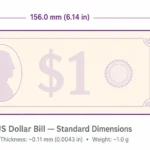
US dollar bill Exact Size measures 156.0mm × 66.3mm. It weighs about 1.0g.
Dimensions
| Length | 156.0 mm |
|---|---|
| Width | 66.3 mm |
| Weight | 1.0 g |
How Big Is a US Dollar Bill? Dimensions Compared to Everyday Items
Every American has handled a dollar bill hundreds of times, but ask someone its exact size and most people just shrug. It’s “small,” it’s “rectangular,” it fits in a wallet — that’s about as far as the mental picture goes. Turns out the US dollar bill is actually one of the most precisely standardized objects in daily circulation, and its dimensions haven’t changed in almost a century.
Below you’ll find the exact measurements, the metric-to-imperial conversions, and a bunch of everyday comparisons that make the size easier to actually picture.
Quick Answer: How Big Is a US Dollar Bill?
A US dollar bill measures 156.0 mm × 66.3 mm, which works out to 6.14 inches × 2.61 inches. It weighs right around 1.0 gram — light enough that a stack of a thousand bills weighs about a kilogram, oddly enough.
US Dollar Bill Dimensions at a Glance
| Measurement | Value (mm) | Value (inches) |
|---|---|---|
| Length | 156.0 mm | 6.14 in |
| Width | 66.3 mm | 2.61 in |
| Thickness | ~0.11 mm | ~0.0043 in |
| Weight | 1.0 g | 0.035 oz |
Every denomination — the $1, $5, $10, $20, $50, and $100 bill — shares this exact same footprint. Only the printed design, security features, and ink change from bill to bill. The size itself has stayed identical since 1929, when the US government shrank the currency down from its earlier format of 7.4218 × 3.125 inches to save on paper and printing costs.
What Does a Dollar Bill Look Like in Size?
Picture a long, narrow rectangle — noticeably more elongated than a standard playing card, and a fair bit smaller than a sheet of paper. At 156.0 × 66.3 mm, the bill is roughly two and a half times longer than it is wide, which is part of why it slides so easily into a wallet slot or a shirt pocket without folding.
If you’ve ever tried stacking bills and noticed how they line up almost perfectly edge to edge, that’s not an accident — it’s the same reason ATMs, vending machines, and cash registers can be built around one fixed set of dimensions instead of needing to handle a dozen different sizes.
7 Everyday Comparisons That Help Visualize a Dollar Bill
Numbers alone don’t always stick. Here’s how the bill stacks up against things you probably already have lying around.
1. A Standard Credit or Debit Card
A credit card measures 85.6 × 53.98 mm. The dollar bill is noticeably longer — about 70 mm longer, in fact — but only around 12 mm wider. Lay them side by side and the bill looks like a stretched-out version of the card.
Comparison: Longer, similar width.
2. A Smartphone
Most modern phones, the iPhone 15 Pro Max included, land close to 160 mm in length — practically identical to the dollar bill’s 156.0 mm. Width is where they diverge: a phone is roughly double the width of a bill. So a dollar bill is basically “phone-length but skinny.”
Comparison: Very close in length.
3. A Business Card
Standard US business cards run 88.9 × 50.8 mm — noticeably smaller than a dollar bill in both directions, but similar enough in proportions (both are elongated rectangles) that the shape comparison holds up well.
Comparison: Smaller, similar shape.
4. A TV Remote
A typical remote control is somewhere around 150–200 mm long and 40–50 mm wide — genuinely close to dollar-bill territory. If you’ve got one on your coffee table right now, it’s probably not far off.
Comparison: Similar length and width range.
5. A Pack of Gum
Classic stick gum packs run close to 90 × 45 mm — smaller than the bill, but in the same general shape family. Two packs laid end to end roughly match a bill’s length.
Comparison: Smaller, similar proportions.
6. A Standard Envelope (No. 10)
A No. 10 envelope measures about 241 × 105 mm — considerably bigger than the bill in both dimensions, which makes sense given it’s designed to hold a folded Letter-size sheet. Still, a dollar bill slides into one with plenty of room to spare, unfolded.
Comparison: Bill is noticeably smaller.
7. A House Key
This one’s less about matching dimensions and more about a length reference: a standard house key runs around 55–65 mm — meaning the width of a dollar bill (66.3 mm) is almost exactly one key’s length. Handy mental shortcut if you’re trying to eyeball the bill’s shorter side.
Comparison: Width matches roughly one key length.
How Big Is a Dollar Bill in Centimeters?
For anyone thinking in metric:
- 15.6 cm long
- 6.63 cm wide
- about 0.011 cm thick
So roughly 15.6 × 6.6 cm — small enough to fit comfortably in a coat pocket without folding, but too long to slip into most coin pouches flat.
Dollar Bill Size in Millimeters
| Measurement | Value |
|---|---|
| Length | 156.0 mm |
| Width | 66.3 mm |
| Thickness | ~0.11 mm |
That thickness figure is for a single, freshly printed bill. Worn bills that have circulated for a while tend to be slightly thinner and softer, since the cotton-linen blend paper gradually loses fiber with handling.
How Much Does a Dollar Bill Weigh?
A single bill weighs about 1.0 gram, regardless of denomination — a $1 bill and a $100 bill weigh exactly the same, since they’re printed on identical paper stock. That means:
- 100 bills ≈ 100 grams (about 3.5 oz)
- 1,000 bills ≈ 1 kilogram (about 2.2 lb)
It’s one of the more fun facts about US currency — a briefcase stuffed with a million dollars in $100 bills would weigh about 10 kg (roughly 22 lb), which is a lot lighter than movies tend to make it look.
Does Dollar Bill Size Vary by Denomination?
No — and this trips a lot of people up the first time they hear it. Every US bill currently in circulation, from the $1 up through the $100, is printed at the exact same 156.0 × 66.3 mm size. The only differences are the portrait, color accents, and security features specific to each denomination.
This wasn’t always true. Before 1929, US currency came in larger, slightly varying sizes. The Treasury standardized everything to the current compact size that year, mainly to cut down on paper costs and make handling easier for banks.
Dollar Bill vs. Other World Currencies
Compared internationally, the US dollar bill runs on the smaller side. A €50 banknote, for example, measures 140 × 77 mm — shorter but noticeably wider than the dollar. Many countries also vary banknote size by denomination (larger bills for higher values), which the US does not do — every American bill, big or small in value, is identical in size.
Dollar Bill vs. US Coins
It’s worth putting the bill next to its coin counterparts too, since they’re the other everyday cash people carry. A US quarter is about 24.26 mm across — small enough that roughly six and a half quarters, lined up edge to edge, would match the bill’s length. A US penny is even smaller at 19.05 mm, making it the more compact of the two coins by comparison.
Common Mistakes When Comparing Dollar Bill Dimensions
Mistake 1: Assuming bigger denominations are physically bigger — A $100 bill is the exact same size as a $1 bill.
Mistake 2: Confusing old and new bill sizes Pre-1929 US currency was significantly larger; don’t apply modern dimensions to older or novelty bills.
Mistake 3: Ignoring wear and tear A well-circulated bill can measure very slightly smaller than a crisp new one, due to fraying edges.
Mistake 4: Mixing up US and international bill sizes Foreign banknotes are often a different size entirely, even when the currency looks superficially similar.
Frequently Asked Questions
How long is a US dollar bill?
A US dollar bill is 156.0 mm (6.14 inches) long.
How wide is a US dollar bill?
It’s 66.3 mm (2.61 inches) wide.
How much does a US dollar bill weigh?
About 1.0 gram, no matter the denomination.
Are all US dollar bills the same size?
Yes. Every denomination from $1 to $100 shares the same 156.0 × 66.3 mm dimensions.
How thick is a dollar bill?
Roughly 0.11 mm (0.0043 in) thin enough that about 230 bills stacked together measure close to 1 inch.
What is a dollar bill made of?
US currency paper is a blend of 75% cotton and 25% linen, not standard wood-pulp paper which is part of why it holds up so well to folding, washing-machine mishaps, and general wear. That fiber blend is also why a bill can reportedly survive about 4,000 double folds (back and forth at the same crease) before it actually tears, and why the average bill stays in circulation for roughly six months to a year and a half before the Federal Reserve pulls it for being too worn.
Final Takeaway
A US dollar bill measures 156.0 × 66.3 mm, or 6.14 × 2.61 inches a long, narrow rectangle close in length to a modern smartphone but far skinnier. It weighs about a gram, and that size and weight hold true across every denomination in circulation, a standard that’s been locked in place since 1929.
Next time one’s sitting on your desk, it’s a surprisingly handy quick-reference for eyeballing the size of smaller objects its width alone is a near-perfect stand-in for a house key, and its length gets you most of the way to a modern phone.
More Household Items
Similar in Size
More Household Items




Frequently Asked Questions
How long is a US dollar bill Exact Size?
A US dollar bill Exact Size is 156.0mm (15.6cm) long.
How much does a US dollar bill Exact Size weigh?
A US dollar bill Exact Size weighs about 1.0g.